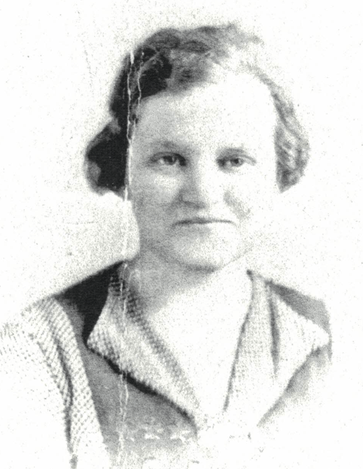
I wrote a small post on Facebook about the use of Artificial Intelligence and used my grand aunt as an example. (In Norway we use the term grand-tante, so here I use grand rather than great, since both are correct in the English language.) I then decided that she deserved to be presented in a post of her own. She was a person I had the privilege of meeting a few times once in the U.S in 1968 and then a few times in Norway in the seventies. I have fond memories of her.
Gunvor was born in 1898 in Kristiania (later called Oslo) on the 23rd of December. She was most likely born at home in Just Høegs Gade, at Hammersborg. This is a central part of Oslo; I remember that my grandfather told us that he had lived at Hammersborg. Her father, Finn Christensen, was a clerk in a book bindery, her mother, Marie Elida Jensen, used to work at one before she was married, perhaps the same one?
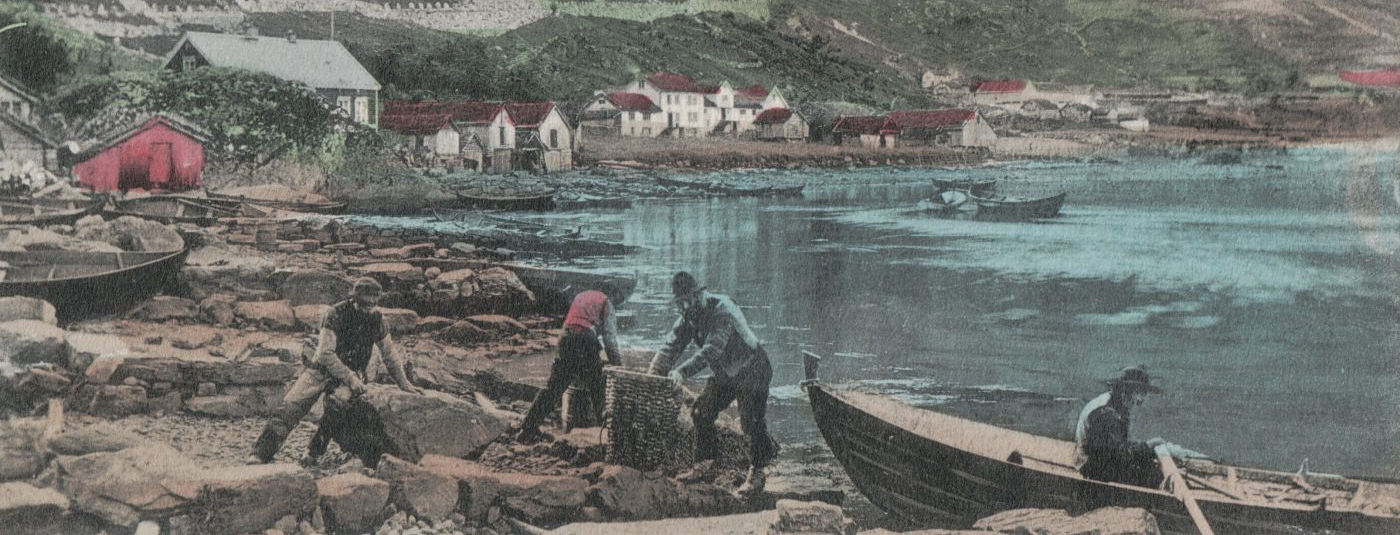
Gunvor and her brother Trygve are the only children without the middle family name Bratli, a memory of their distant rural past and using it was a symbol of nationalism. The family had another child, Rolf Bratlid (the name had different spellings; Bratli, Brattli, Brattlie, Brattlied, Bratlid) Christensen, my grandfather. In all there were eight children born between 1897 and 1919, six boys and two girls. Two died as infants. The first three children were born in the capital; Kristiania, while the last ones were born in Notodden, an industrial town, made even more important with the establishment of Norsk Hydro in 1905, an industrial giant in Norwegian history.
Norsk Hydro produced mineral fertilizer, specifically calcium nitrate in a process using hydropower. This was her father’s employer since June of 1906. The family came to Heddal shortly before this, her father, Finn, found a job digging ditches before he started at Hydro. Finn had lost his job in Kristiania, and he received money from the poor relief board. Before moving to another county, one was obliged to repay the grant, but the family fled and got away with it.
Heddal is now called Notodden, and is famous for one of the most iconic stave churches in Norway. Gunvor was seven at the time, so most likely she started school there.
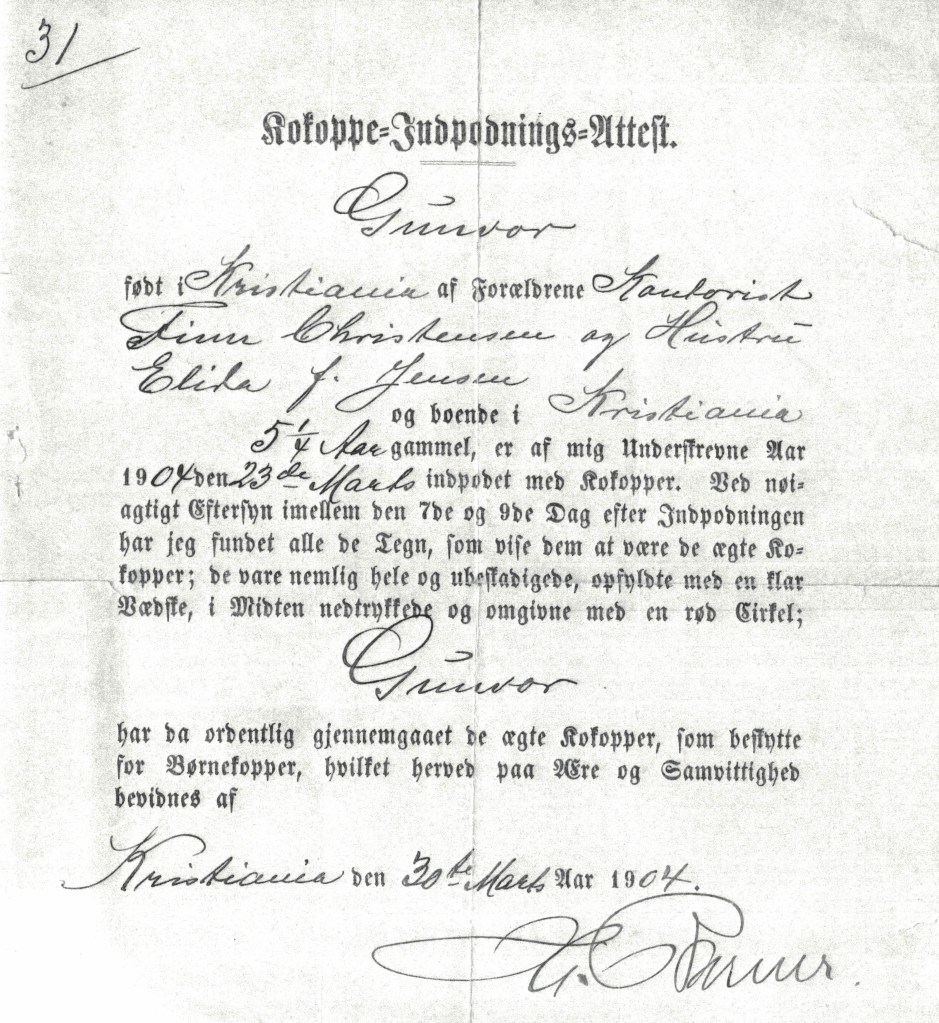
In 1915 she went to confirmation preparation, the ceremony was on the 5th of December. Gunvor was the last one on the list of females, she was born two years before most of them. Knowing my family, I would guess that her parents were just late in signing her up. One clue is that her parents only married seven days before the first child Rolf was born. Another reason can be that the father was not a member of the church, perhaps he did not want his children to be confirmed. In the registration of the confirmation, it is recorded that Gunvor had been vaccinated for smallpox in March of 1904.

The family lived in Grønnbyen in 1915, dwellings built for employees at Norsk Hydro. It consisted of 25 houses with two apartments in each and three houses for caretakers. The houses were of high quality for the time. The residents were obliged to let one room in each apartment, so they had only one bedroom!
We know little about this period of Gunvor’s life, but her schooling was probably at first primary school from the age of seven. She would have finished that at age 14. She might have taken Middelskolen (junior High School), some of her younger brothers attended senior high school, Gymnas, but being a girl, she probably did not. Leaving school and being confirmed at the same time (1915), was the usual pattern.
So, if she at the age of 15 finished school she had to look for work. Her father was a very charismatic man, and an influential union man, so she might have had some help from him in finding employment. She ended up as a telegrafistinne (telegraph operator), according to tax-records published in the local papers and her emigration record. So did she have a vocational education to be able to work for the telegraph industry? Female employees were paid much less than men in the same role. In 1926 she emigrated. Her brother Ragnar, born in 1903, had already emigrated to Chicago. Brother Odd came three years later.
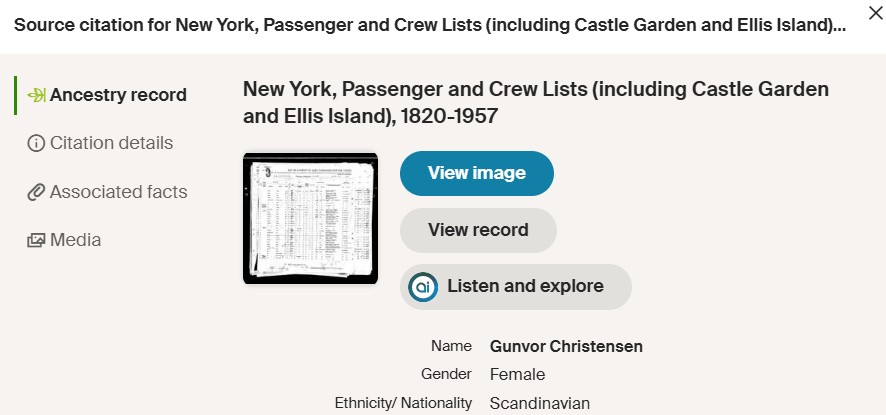
The New York Passenger and Crew Lists note her as single, 27 years old, living at her parents’ home until emigration, leaving for a permanent residency and her intention is to stay with her brother Ragnar in Chicago. She has $40, is 5 feet 1-inch tall, blonde, with a fair complexion and blue eyes. She sailed with the ship Bergensfjord, and arrived in New York on March 10th, 1926. At first she worked as a nanny.
You can listen to Gunvor’s story: A Scandinavian Journey to New York, made by Ancestry’s AI feature Listen and Explore here:
The Scandinavian emigrants intermingled, so it was not surprising that Gunvor married a Swede, Carl Bertil Bernstrom. He was educated as an engineer in Sweden. They married in Chicago on the 7th of January 1928. Her brother Ragnar also married a Swede, Anna Aranson. Her father Finn died a year later. Ragnar went home to visit, but she stayed.
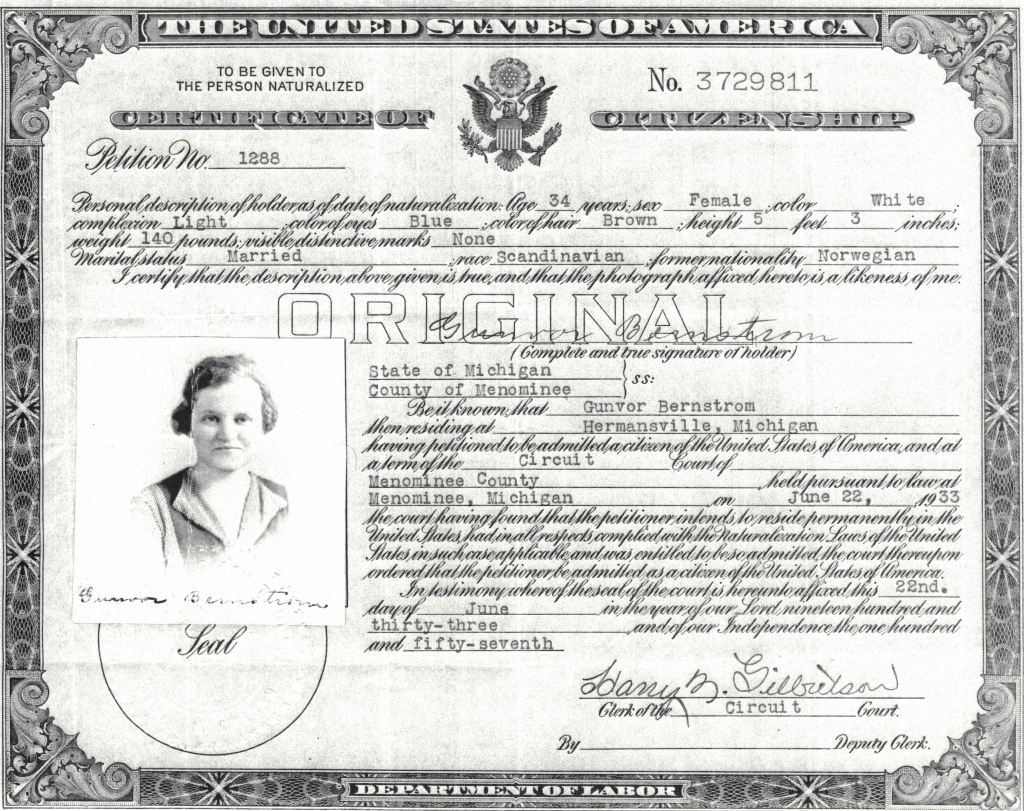
In 1933 Gunvor received her Certificate of U.S. Citizenship. The couple then lived in Hermansville, Michigan, which is in Michigan’s Upper Peninsula.
But around the end of year 1933 or in 1934 Gunvor and Bertil (as he was called) went back to Scandinavia. It was said that this was a spur of the moment decision. The kettle was still on the stove in their home. They stayed in Stockholm, we know this because their daughter Berit Margareta was born there in February of 1934, and was christened in the Saint Göran parish church. During their time in Scandinavia, the Bernstrom family also visited Gunvor’s Norwegian family in Notodden. In all they stayed for three years, Bertil left for the U.S. before Gunvor and Berit. (A son Richard was born in 1938.)
When researching Gunvor, I have used Norwegian resources at the Digital Archives of Norway. For the events in the U.S. and also some in Norway and Sweden, I have used Ancestry. The newly released Ancestry feature “Listen and Explore” has given complementary information to Gunvor’s life. Not all records will be improved by this feature, for her I found it on an Emigration record and a U.S. City Directory. Becoming familiar with the vast array of features, tools and more on Ancestry, makes your family history even richer.
Thank you to Heidi Anita Nyhus Bjaaland, Margaret Strand and Shelley Donahue for help with this post.
 Genealogical research in Norway
Thank you for sharing this wonderful story. The new Ancestry’s AI feature Listen and Explore is new to me. Listening to the audio makes Gunvor’s story come to life, and this is something that I need to explore and learn more about.
LikeLike