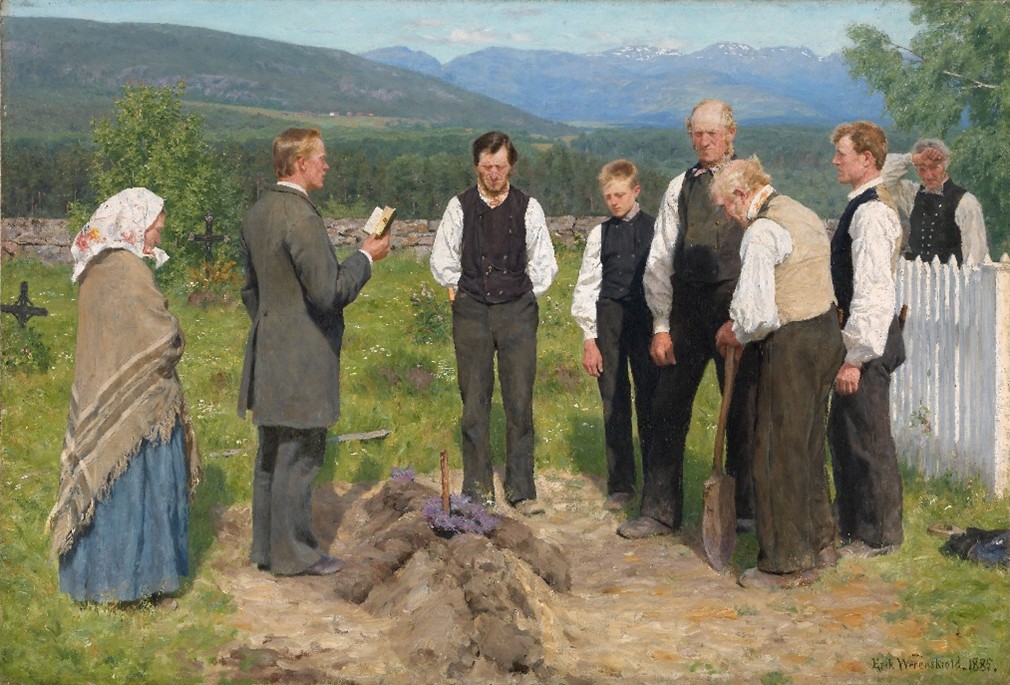
One of the most iconic paintings in Norway is En bondebegravelse, in English “a peasant burial”. The picture is painted in the 1880’s by Erik Werenskiold. To characterize him: he was a central artist in Norway who shaped national identity.
Here we will have a look at a photo of a funeral in a rural district, from Storligrenda. Storli or Storligrenda (the Storli hamlet) consisted at this time of six small mountain farms. The altitude is 600 meters above sea level, and the farmers cultivated grain, potatoes, had livestock, fished, hunted and had income from different kinds of handiwork (cobblers, tailors and weavers). Tourists were also a source of income. The distance to the nearest store was 20 kilometers. And there was no road open (snow-cleared) in wintertime until 1959. The church was situated not far from the store, but there were no services every weekend since the minister also had the responsibility of the main church in Oppdal, also in the Oppdal municipality.
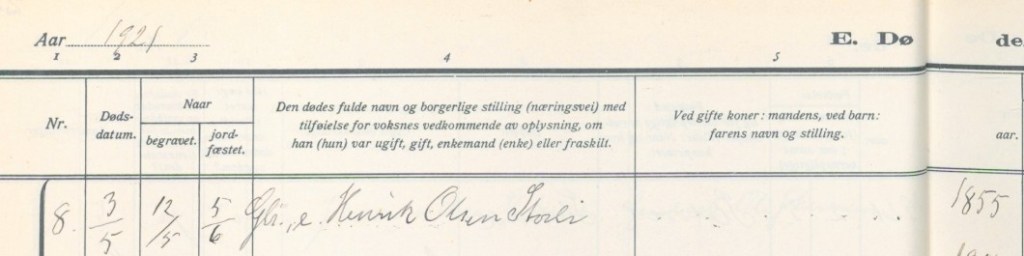
The picture below shows great grandfather Henrik Olsen Storli’s death record. It says: Death May 3rd, buried May 12th and committal ceremony (jordpåkastelse) June 5th. It is nine days between death and burial, but a long time before the committal ceremony. This is because he died in May, and the ground was probably covered with snow so the casket could not be transported to church or buried in the ground. In the meantime, the casket was placed in the barn at the place of death, with the lid off so that everybody that wanted could see the dead person. Back then, there was no ceremony in the church, only the committal by the graveside by the minister.
I found the funeral photo shown below among other pictures, indicating that they were not among the most important to my family. In my collection I have two burial pictures, one of my great grandfather and the other of a neighbor. My morfar (mother’s father) was born in the hamlet and lived on the Storli farm, Jelhaugen. The one of my great grandfather’s casket, with many people surrounding it, has been analyzed by my mother, in order to name as many as possible of the participants.
When I found this burial photo, I went ahead trying to figure out what it could tell me about the people there, customs and more. First of all, I had to identify where it was taken. I did not recognize the farmhouse. I posted the picture on Facebook in the group Gamle bilder fra Oppdal (old photos from Oppdal), and asked for help. Within a few hours I had an answer from somebody who knew it was the Ustigar farm. I could then look for somebody who belonged there, that had died.
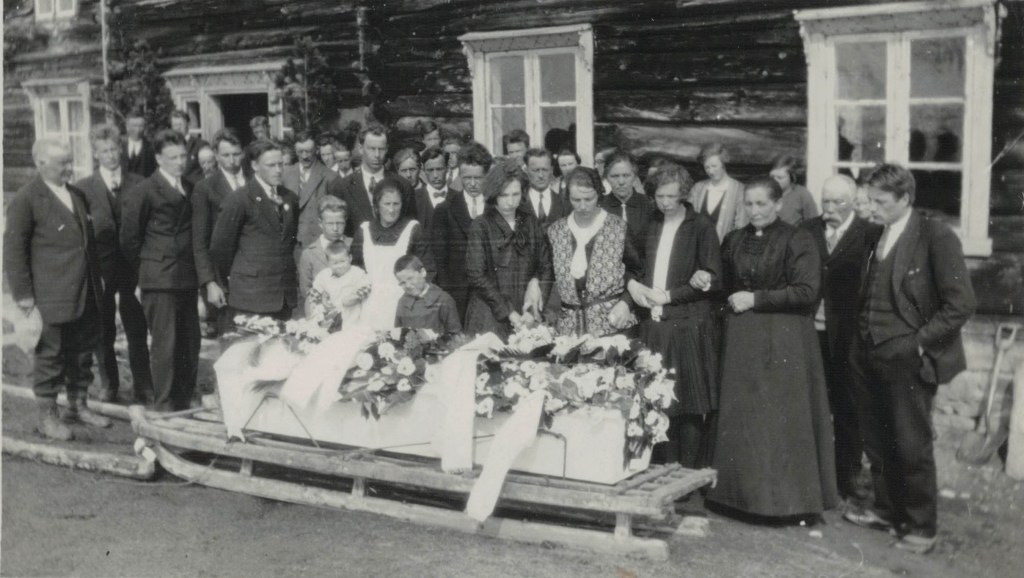
Some of the participants are family, others belong to their FAN-circle. I do think that the photo was taken by a local man, based on information from previous photos, the result is impressive by my standards. One can clearly see the heads of quite a few of the photographed people. Is there any significance in the grouping of the persons in the first row? The five men? The woman with three children around her. And the woman on the right, in front, with three younger women? And who died?
I started my analysis by looking at the woman with three children. I believe she was called Hanna, I recognize her, she lived next to my family’s farm and next to the farm where the burial took place. And there are her children, Arne, Gunnar and Petra, and if Petra is 2-3 years old, the picture was taken around 1931-1932.
I then turned to the Bygdebok (farm bok or rural chronicle) of the area: Lønset og Storlidalen. I started by going through the names of the people at the farm where the burial took place. But no one there died during this period. Then I was told that the woman standing next to the three girls, Marit Halvorsdatter Rate, had two children before she married, and one of them was Sverre, born in 1909, and died on April 13th, 1931. This agrees with the small girl’s age, she is almost two years old in the picture! To the left of Marit is her daughter, a neighbor’s girl and another daughter. Her husband Ingebrigt Knutsen Storli is on the right while the younger man on the far right is the local teacher, Sigurd Bøasæter. He was probably the one who preached that day, that is he held the memorial speech.
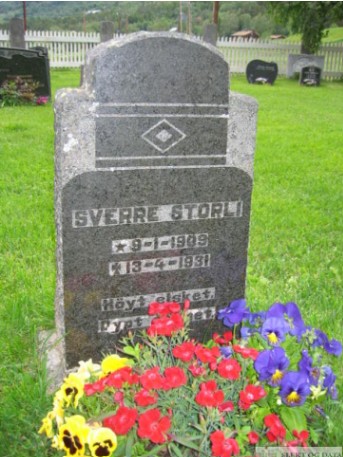
Sverre’s full name was Sverre Sivertsen Bø or Storli, but he was only recorded as Sverre Sivertsen at the time of his death. He died from pneumonia, according to those who knew him. The scanned church records from 1931 are not accessible, but the transcribed version is. His date of death is all that is disclosed.
Another group of people are the five men on the left of the picture. The elder man is probably Ole Henriksen Vasli, Sverres’s employer at the farm Vasli Ångarden. Perhaps the other men are employees on the same farm.
The casket is placed on a sledge. The picture was taken in April, there would probably still be snow in the terrain, but not in front of the houses. The sledge would be used to drag the casket to church, 18 kilometers away. They would probably have a few horses, from the nearby farms, leading the procession. Also, a few men would go along, but the distance was too far for all the others to go. One can see what looks like flowers one top of the casket. These are probably artificial, perhaps made of paper with sprigs of spruce in-between. There were a lot of customs in relation to the preparation, invitations, food, and placing at the table for the event. The terms being (invitation) and beningskurver/sendingskurv (the wooden container or basket used) described the local customs.
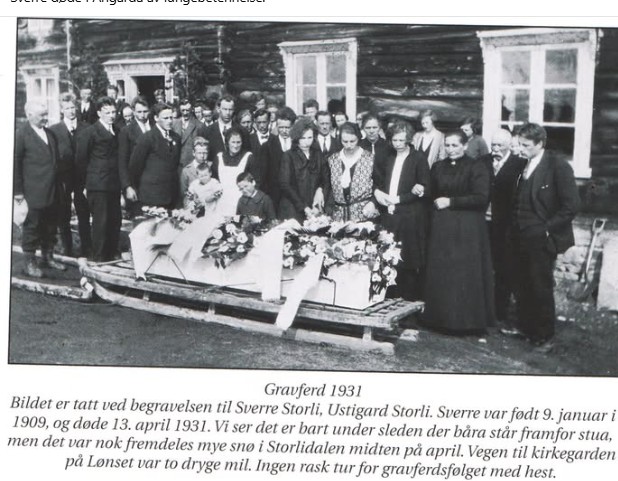
I have asked local people for help, and some of it has been very valuable. One important contribution is this clipping from a local book, this is from 2013, 82 years after the event. The facts there agree with my analysis, but those who contributed to the book, have not experienced the event themselves. As a genealogist, should we consider it to be relevant background information?
I have only just started my research into this picture and who was there, and what the customs regarding funerals in Oppdal were. I have many more questions which I will be sure to ask in the years to come, but for some of them is too late, those who know are long gone.
I want to thank Margaret Strand, Heidi Anita Nyhus Bjaaland, Harald Jære and Facebook-friends for help.
 Genealogical research in Norway